Lifestyle
Benefits for how your team actually lives
Phone bill subsidies, co-working day passes, and café credits — for hybrid teams who work everywhere.
Hybrid work has changed what 'work costs' means. For employees working from home or on the road, the phone bill, the co-working day pass, and the café where they take client calls are real business expenses that come out of personal income. The lifestyle benefit puts that right.
15 min
Phone credit loads within
40+
Co-working partners
20+
Networks supported
All venues
One QR for
The benefit explained
What is it, exactly?
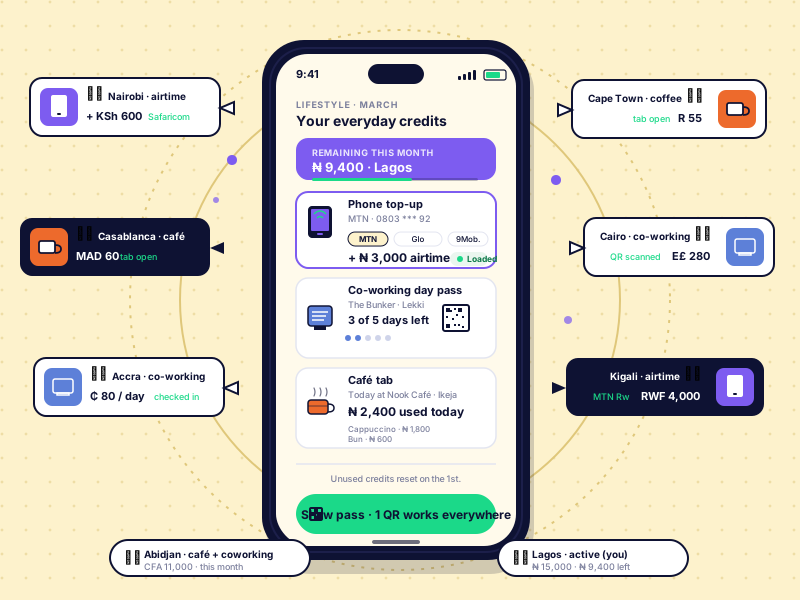
A bundle of lifestyle credits covering the everyday costs of modern work: mobile phone top-ups loaded directly to employee numbers, co-working space day passes, and café credits for partner locations. Especially valuable for hybrid and remote teams.
Step by step
How it works
From setup to employees spending — here's the full flow.
Employer sets a monthly lifestyle credit per employee.
Employee selects how to use it — phone top-up, co-working day pass, or café credit.
Phone credit loads to their number within 15 minutes of confirmation.
Co-working and café passes are QR codes issued instantly in the app.
Credit resets monthly.
Full coverage
What's included
The difference
Before RibiBenefits vs. after
- Remote employees absorb phone and workspace costs personally
- No company support for co-working spaces
- Ad-hoc expense claims for work-from-home costs
- Office workers get a canteen; remote workers get nothing
- Benefits package feels irrelevant for hybrid staff
- Monthly lifestyle credit covers phone and workspace costs
- 40+ co-working partners in major cities
- No receipts, no claims — credit in app
- Equitable benefit for office and remote workers
- Benefits package designed for how they actually work
For your organisation
Why HR teams choose it
Support hybrid workers
Hybrid teams have real costs that office workers don't — home internet, phone bills, co-working spaces. This benefit addresses that directly.
High perceived value, low cost
Phone bill top-ups and café credits are low-cost to fund but highly visible to employees who use them weekly.
Works everywhere you operate
We activate local telcos, co-working spaces and cafés per city — not just in one market.
Targeting
Who is this benefit for?
This benefit works across many employee profiles. Here's where it has the most impact.
Hybrid and remote teams
The lifestyle benefit was designed for this cohort. Phone, café, co-working — these are their actual work costs.
Sales and client-facing roles
Reps who take calls from cafés and co-working spaces spend real money on those environments. This covers it.
Tech companies and startups
Companies with flexible work cultures use lifestyle benefits to formalise the implicit support for remote-friendly working.
Younger workforce demographics
Café culture and co-working are natural environments for younger employees. This benefit resonates particularly well with teams aged 22–35.
The question Finance always asks
Why not just pay a home-office allowance?
Home-office allowances disappear into general expenses — employees can't tell you a month later what they spent it on. A lifestyle credit is used for lifestyle: phone, café, co-working. It's visible, frequent, and associated with your brand every time they tap their card at the café counter. That daily association is what builds loyalty.
The perception gap
Equivalent cash added to salary
55% perceived value vs cost
Named benefit credit
87% perceived value vs cost
Based on RibiBenefits employee surveys across African markets, 2024.
Employee perspective
What employees get
Benefits only work if employees actually use them. Here's why they do.
Phone credit in 15 minutes
Confirm your operator, hit confirm. Your airtime loads within 15 minutes. SMS from your network confirms it.
Work from anywhere
Co-working day passes let you escape home or skip a long commute. Pick a space near you on any given day.
Café tab included
Generate a QR for a partner café and use it all day — coffee, lunch, or just a quiet desk.
“We're fully remote. Our team doesn't have an office canteen or free coffee. The lifestyle benefit — especially the café credit — was our way of replacing what office-based companies take for granted. Employees mention it in every people survey we run.”
Where it works
Available markets
Tax & compliance note
Phone bill and connectivity subsidies are generally treated as work-related expenses and can be structured to be tax-efficient in most African markets. Co-working passes have variable treatment depending on jurisdiction. We'll advise on your specific market during onboarding.
Common questions
Questions
Build your package
Pair it with
Most companies combine 3–5 benefit categories. Here's what works well alongside lifestyle.
Ready when you are
Add Lifestyle to your package
Book a demo and we'll show you exactly how it works for your team and markets. Most companies go live within two weeks.
- No procurement process — one contract
- Go live in 2 weeks or less
- Dedicated onboarding support included
- Cancel any time, no lock-in